Why momentum fails in the middle.
Answer first: the middle fails when the plan still asks for start-of-project energy. Protect the cue, shrink the promise, and make the next review visible before you rebuild the whole system.
Quick answer
Why does momentum fail in the middle?
Momentum often fails in the middle because the early reward has faded, the finish is not close enough to pull you forward, and the system asks for the original promise instead of the smallest repeatable version.
The middle is where a good plan stops feeling like a clean decision and starts behaving like ordinary work. If the cue is hidden, the promise is too large, or the review is vague, the plan has no way to survive the flat stretch.
Middle map
The middle needs less drama and more visible structure.
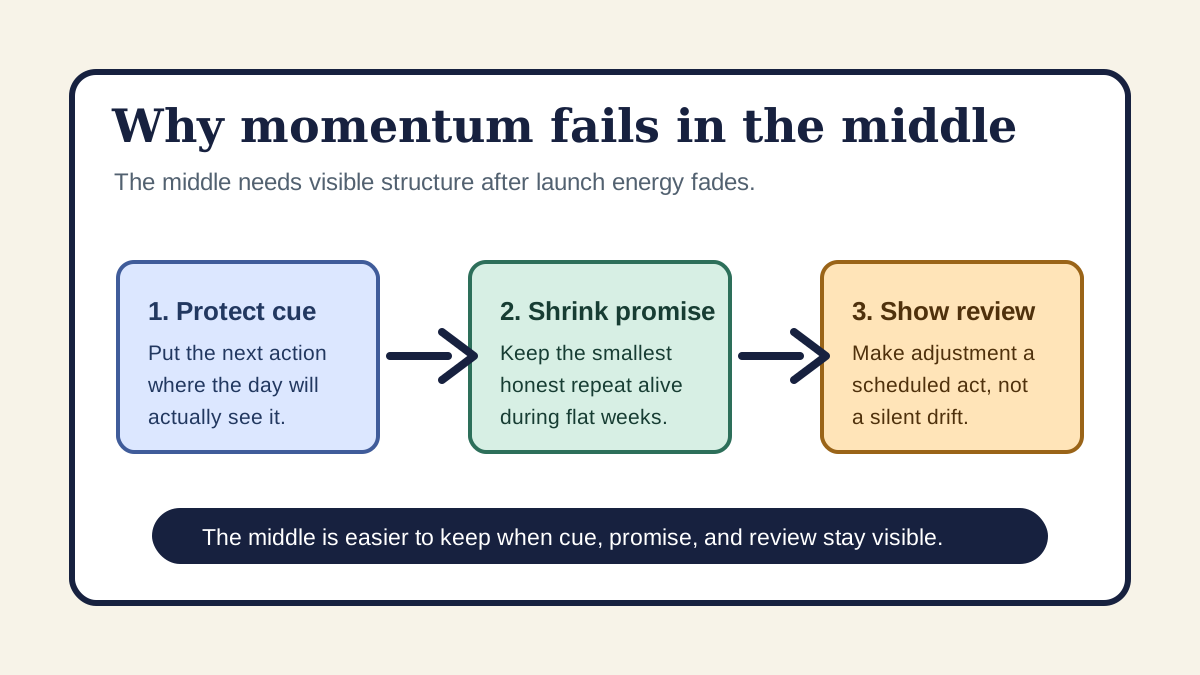
Before adding a new system, check whether the current one has lost one of the three supports that made it repeatable.
- Protect the cue
- Put the next action back where the day will actually see it: calendar, desk, shoes, document, or shutdown note.
- Shrink the promise
- Choose the smallest honest version that keeps continuity without pretending the middle still has launch energy.
- Show the review
- Make the next review date visible so the plan has a scheduled adjustment point instead of a silent fade.
The middle is not a motivation test.
Most people diagnose the middle as a character problem. They had a good start, they lost intensity, and they assume the answer is more discipline. But the middle is usually a design problem: the plan was built for commitment, not repetition.
Start energy is loud. It creates its own cue. It makes the first week feel meaningful. The middle removes that signal. If the system depends on feeling newly committed, it will begin to wobble exactly when the work needs to become normal.
Use the middle check before another reset.
- Find the missing cue. Ask where the next useful action is supposed to become obvious without relying on memory.
- Lower the promise without lowering the identity. A small repeat still says "I am the kind of person who returns."
- Schedule the review. Make adjustment a planned act, not a reaction to one low-energy day.
Practical examples
What the middle version can look like.
- Writing: open the draft and write one useful paragraph before measuring the session.
- Fitness: do the warm-up and one set when the full workout is too expensive.
- Reading: keep the book visible and finish one page before switching screens.
- Planning: write tomorrow's first move before adding another productivity system.
- Recovery: keep the evening cue even when the perfect shutdown routine is unavailable.
Where the seven-layer model helps.
In Compounding Momentum, momentum is not treated as a mood. It is the result of layers that make the next useful action more likely: identity, belief, environment, cue, action, feedback, and review.
When the middle fails, one of those layers has usually become invisible. The work is not to shame yourself back into the launch version. The work is to make the weak layer obvious enough to repair.
Use this script
The middle-preservation rule.
Use this before replacing a plan that is flat but still useful.
- The cue I will see is...
- Name the physical or calendar signal that will make the next action visible.
- The middle-sized promise is...
- Name the repeat that is small enough for a low-energy day and still honest.
- The review happens on...
- Choose the date when you will adjust the system instead of drifting away from it.
When to keep reading.
If the middle feels boring, read when progress starts to feel boring. If the plan is still too vague, read when the plan is too abstract to start. If the week has no margin, read when the week has no margin left.
Take the smallest useful next step.
If you are in the middle, choose one route that restores visible structure before you start over.